

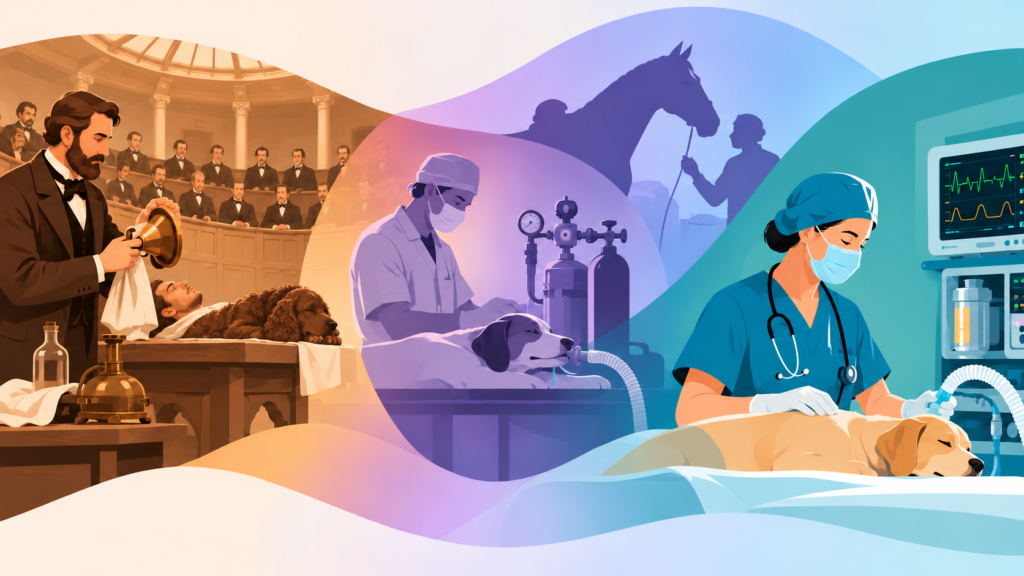
From the first experiments with ether to modern monitoring and multimodal analgesia, the history of veterinary anesthesia reflects nearly two centuries of scientific progress and changing attitudes toward animal welfare.
On this day in 1846, dentist William T. G. Morton administered diethyl ether to a patient undergoing surgery at Massachusetts General Hospital in Boston. The successful public demonstration, performed in what would become known as the Ether Dome, helped transform surgical practice by demonstrating that operations could be performed without the suffering previously considered unavoidable.
Today, October 16 is celebrated as Ether Day, or World Anesthesia Day, in recognition of this milestone in general anesthesia.
But the story of anesthesia did not begin with that famous demonstration. In fact, animals played an important role in the experiments that preceded it. And within months of Morton’s demonstration, veterinarians were already exploring how this revolutionary discovery could benefit their own patients.
1846: Morton’s Water Spaniel and the Demonstration of Ether Anesthesia
Before his historic demonstration, Morton conducted experiments on various species of animals to investigate whether ether could reliably produce unconsciousness. One of his experimental subjects was his own pet water spaniel.
According to historical accounts, Morton administered ether vapor to his dog and observed him becoming unconscious and unresponsive. Panicked, Morton feared that he had accidentally killed his pet, only recognizing the momentous breakthrough when the dog subsequently regained consciousness.
Although it would likely be considered unacceptable by modern animal welfare standards, this experiment helped convince Morton that ether could produce reversible unconsciousness. He subsequently experimented on himself and administered ether to dental patients before the famous public demonstration on October 16, 1846. These early investigations helped establish the foundation for a scientific revolution that would eventually transform both human and veterinary medicine.
1847–1850: The Arrival of Veterinary Anesthesia
Before the introduction of general anesthesia, surgery in both humans and animals was an extraordinarily unpleasant experience. Physical restraint, speed, and the occasional use of sedative substances were among the limited options available to practitioners.
The introduction of general anesthesia changed what was possible.
News of Morton’s demonstration spread rapidly across Europe, and veterinarians were among those eager to investigate its potential applications. In early 1847, Austrian veterinarian Joseph Seifert investigated ether anesthesia in horses and other animals in Vienna. His work represents some of the earliest documented veterinary applications of inhalational anesthesia.
That same year, British veterinarian Edward Mayhew reported experiments with ether in dogs and cats. His observations revealed an important challenge: although the animals appeared insensitive to surgical stimulation, excitement and vocalization during induction raised concerns about whether the experience was truly humane. These early debates illustrate a distinction that remains important today: immobility, unconsciousness, and analgesia are not necessarily the same thing.
In 1847, Scottish physician James Young Simpson introduced chloroform as an alternative to ether. Chloroform was subsequently adopted in veterinary practice, although its potentially serious cardiovascular effects would become increasingly apparent.
The first generation of veterinary anesthetists had discovered how to produce unconsciousness. Understanding how to do so reliably and safely would take much longer.
Late 19th Century: Progress, but Limited Adoption
Despite the availability of ether and chloroform, general anesthesia did not immediately become routine in veterinary surgery. Anesthetic administration was technically difficult, particularly in large animals. Equipment was rudimentary, anesthetic concentrations were poorly controlled, and practitioners had few reliable methods of assessing physiologic function.
There were also significant cultural and economic barriers. Veterinary surgeons frequently prioritized rapid procedures and physical restraint, while attitudes toward animal pain differed considerably from modern expectations. Nevertheless, the foundations of anesthetic pharmacology were gradually emerging. Researchers began investigating how anesthetic agents affected respiration, circulation, and the nervous system. The risks of excessive anesthetic depth became increasingly apparent, establishing the need for careful observation during anesthesia. The central challenge was shifting from whether anesthesia could be achieved to whether it could be maintained safely.
Early 20th Century: Beyond Ether and Chloroform
The early twentieth century brought important advances in anesthetic drugs, equipment, and techniques. The development of injectable anesthetics offered alternatives to inhalational anesthesia, and improvements in oxygen delivery and breathing systems made anesthetic administration more controllable.
Barbiturates became particularly important following the introduction of thiopental in the 1930s. Rapid intravenous induction became a practical option in many clinical settings. Meanwhile, endotracheal intubation, improved anesthesia machines, and techniques for assisted and controlled ventilation expanded the range of procedures that could be performed under general anesthesia.
These developments were especially important in veterinary medicine, where enormous differences in patient size, anatomy, and physiology made a single approach to anesthesia impractical. A cat, a horse, and a cow presented very different anesthetic challenges. Increasingly, anesthesia techniques had to be adapted to the species and the individual patient.
Mid-20th Century: The Foundations of Modern Veterinary Anesthesia
The middle decades of the twentieth century marked a transition toward more recognizable modern anesthetic practice.
New inhalational agents, such as halothane, offered safer (and less explosive) alternatives to ether and chloroform. In the 1960s and 1970s, further chemical refinements to halogenated inhalants led to the invention of the modern agents isoflurane and sevoflurane. The development of modern vaporizers, breathing circuits, and anesthesia workstations vastly improved the precision of inhalant delivery.
At the same time, veterinary anesthesiology began to develop as a distinct clinical and academic discipline. In 1970, the American Society of Veterinary Anesthesiology was founded, which would become the AVMA-accredited American College of Veterinary Anesthesia (now the ACVAA) ten years later.
Anesthesia was no longer just a technique used to facilitate surgery. It was becoming a discipline of its own focused on optimization of pharmacology, physiology, perioperative medicine, and the prevention and management of complications.
Late 20th Century: Monitoring Changes Everything
Perhaps one of the most consequential developments in modern anesthesia was the availability of increasingly advanced physiologic monitoring. For much of its history, anesthetic assessment depended heavily on clinical observations: respiratory movements, pulse quality, mucous membrane color, reflexes, and responses to stimulation. While these observations are valuable, they provide an incomplete picture of the anesthetized patient.
The early 1950s saw the introduction of clinical capnometers based on the Luft detector, an infrared device invented by BASF chemist Karl Friedrich Luft around 1943. Another important breakthrough came in 1972, when Japanese engineer Dr. Takuo Aoyagi developed the principle of modern pulse oximetry while working at Nihon Kohden. By recognizing that changes in light absorption caused by arterial pulsations could be used to estimate arterial oxygen saturation, Aoyagi laid the foundation for a technology that would eventually make continuous, noninvasive monitoring of oxygenation routine in operating rooms around the world. Capnography and pulse oximetry are still considered standard anesthetic monitoring devices to this day.
The adoption and refinement of technologies such as electrocardiography, blood pressure monitoring, pulse oximetry, and capnography gave anesthetists new ways to assess cardiovascular and respiratory function. Instead of waiting for obvious clinical deterioration, practitioners could increasingly identify physiologic abnormalities and intervene earlier. These sophisticated monitoring modalities also changed how anesthesia was understood by opening a window to observe ventilation, oxygenation, perfusion, and cardiovascular function. The absence of movement was no longer an adequate measure of anesthetic success.
The Evolution of Pain Management
Historically, the primary objective of general anesthesia was to permit surgery without movement or apparent suffering. However, over time, greater attention was directed toward the physiologic consequences of nociception and the importance of preventing and treating pain. Opioids, local anesthetics, nonsteroidal anti-inflammatory drugs, and other analgesic agents became increasingly important components of veterinary anesthetic protocols.
The concept of multimodal analgesia encouraged the use of complementary drugs and techniques acting at different points along nociceptive pathways. Regional anesthesia techniques also became more widely adopted, providing opportunities to improve analgesia while reducing reliance on systemic anesthetic drugs. The first ultrasound-guided regional anesthesia was performed in 1978, when South African anesthesiologist Philip du Plessis la Grange and colleagues described the use of Doppler ultrasound to identify the subclavian artery as a landmark for brachial plexus block. The first B-mode, ultrasound-guided nerve block would be performed in 1994 by Stephen Kapral and colleagues. These techniques were adopted by veterinary anesthesiologists in the early 2000s and remain part of the standard analgesic repertoire today.
These developments reflected a broader change in veterinary medicine: pain management was increasingly recognized as a fundamental component of animal welfare rather than an optional addition to surgical care.
Veterinary Anesthesia Today: An Increasing Focus on Patient Safety
Modern veterinary anesthesia bears little resemblance to the practices of 1846. Today’s anesthetists have access to sophisticated drugs, precision vaporizers, mechanical ventilators, physiologic monitors, and an extensive body of research to guide clinical decisions.
But technology alone does not make anesthesia safe. Many of the most important improvements in patient safety depend on processes that are considerably less glamorous: thorough preanesthetic assessment, appropriate equipment checks, effective communication, consistent monitoring, timely intervention, and careful recovery management.
Modern anesthesia also recognizes that risk extends beyond the period of unconsciousness. Patient preparation, analgesic planning, temperature management, and postoperative surveillance all influence outcomes. While the primary objective of veterinary anesthesia in 1846 was to render a patient unconscious, today’s priorities are maintaining physiologic stability, preventing unnecessary suffering, recognizing complications early, and supporting a safe recovery.
180 Years Later, the Work Continues
The public demonstration of ether anesthesia in 1846 was a remarkable turning point in medicine. From Morton’s early experiments with his water spaniel to the first veterinary applications of ether, the history of anesthesia has always been closely intertwined with the study and treatment of animals.
Over the following 180 years, veterinary anesthesia evolved through advances in pharmacology, equipment, monitoring, clinical research, and professional education. Yet the history of anesthesia is also a reminder that progress is not inevitable. Many practices once considered acceptable would be difficult to justify today. Improvements in patient care have depended on practitioners questioning established methods, recognizing their limitations, and adopting better approaches as evidence becomes available.
On Ether Day, we celebrate an extraordinary scientific achievement and the generations of clinicians and researchers who built upon it. We should also remember that the responsibility to improve anesthetic care did not end with each invention in the history of anesthesia, and the story of anesthesia is one of continual progress.
If we know better, we should do better.
Thomson Veterinary Education is dedicated to improving veterinary anesthesia through practical, evidence-based education. Our flagship program, Anesthesia Essentials, helps veterinary teams strengthen their understanding of anesthesia, monitoring, analgesia, and patient safety.